SUNYU Photonics - Precision Testing Solutions
Homepage About Us
Product Solutions
Services FAQ News Our Partners Contact Us 中文
核心优势:构建四位一体的测试壁垒

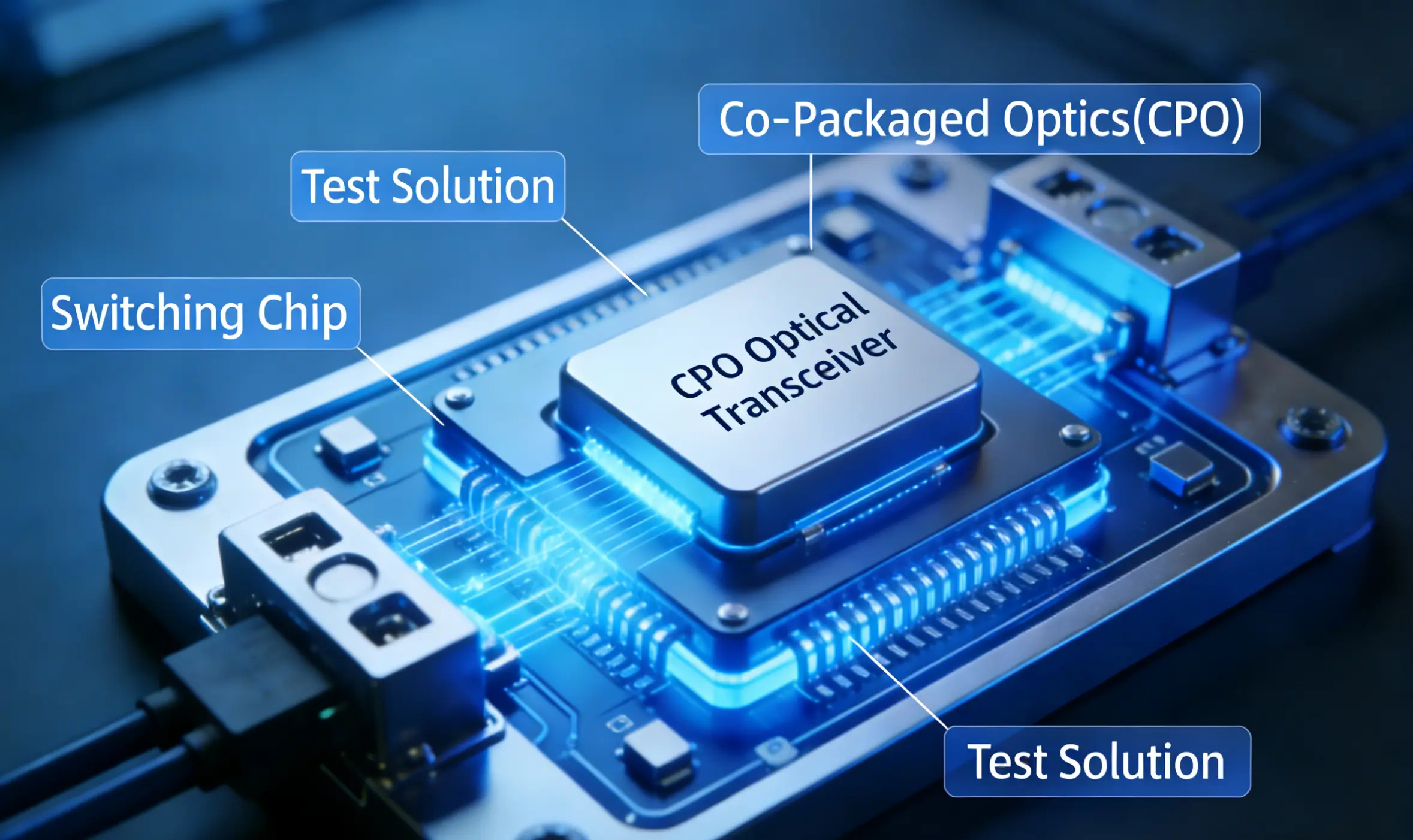
As Co-Packaged Optics (CPO) technology advances toward large-scale mass production, traditional discrete testing processes have emerged as a critical bottleneck. This solution provides a comprehensive end-to-end testing technology system spanning from wafer-level preparation to final sorting, integrating full-dimensional validation of optical, electrical, thermal, and mechanical properties. It delivers mass-production quality assurance and data loop closure for 800G/1.6T and next-generation high-speed optical interconnect devices.

Core Advantage: Building a Four-in-One Testing Fortress​

Interdisciplinary High-Precision Synchronous Testing Capabilities: Electro-Optical Collaborative Validation: Simultaneously executing 112G PAM4 electrical signal integrity validation (receiver sensitivity test, BER < 1E-12) and critical optical parameter measurements (Insertion Loss IL, Polarization Dependent Loss PDL with ±0.1dB accuracy) on a single test platform, accurately simulating the chip's actual operating status and avoiding errors caused by multiple clamping. Structural and Electrical Interconnection: Integrating TSV process quality inspection (via sidewall roughness Ra < 0.1μm to ensure low-loss high-frequency signal transmission) with mechanical bond strength validation (> 50MPa), ensuring interconnection reliability from the physical level.

Micron-Level Ultra-Precision Manipulation and Positioning: Precision Probing: The probe station achieves positioning accuracy as high as 0.5μm, enabling stable and repeatable contact with micro-pads as small as 80×80μm, addressing the probing challenges posed by high-density integration. Precision Bonding: The alignment error in critical processes such as thermocompression bonding is strictly controlled within ±1μm. This metric outperforms general industry standards by over 30% and serves as a prerequisite for achieving high optical coupling efficiency and low link loss.

Extreme Environment and Lifetime Reliability Stress Validation: Dynamic Temperature Cycling: Supports rigorous temperature cycling tests from -40°C to 105°C (with precise ramp rate control at ±5°C per minute) to evaluate potential failures caused by thermal coefficient mismatch in materials. Aging and Shock Testing: Combines high-temperature long-duration aging tests at 125°C with 50 cycles of power cycling shock to accelerate the exposure of early-life failures, ensuring long-term device lifetime and stability under extreme operating conditions.

Data-Driven Closed-Loop Quality Control: All test data is uploaded in real-time to the Manufacturing Execution System (MES). Through big data analysis, process fluctuations are rapidly identified. This establishes a real-time feedback loop of "Testing-Analysis-Process Parameter Optimization," continuously enhancing process capability and product yield.

六阶段技术流程:全覆盖、零遗漏的质控体系

Six-Stage Technical Process: A Comprehensive, Zero-Defect Quality Control System

Phase 1: Wafer-Level Preparation & Preliminary Screening: ​Optical Performance Pre-Screening: Utilizes dual-band (1260-1360nm O-band / 1500-1600nm C+L-band) scanning to quickly and non-destructively identify optically deficient chips. Stable Test Environment: The testing environment is strictly controlled to 23±1°C with Class 10 cleanliness, ensuring baseline consistency and reliability of all measurement data.

Phase 2: TSV and Silicon Photonics Process Validation: Deep Via Etching Quality: Monitors the etching verticality (89-91°) of 5-10μm through-silicon vias, which directly impacts subsequent metal filling quality and electrical performance. Metallization Quality: Performs sidewall roughness (Ra) and defect inspection after copper electroplating filling to control signal transmission loss and reflection at the source.

Phase 3: High-Speed Electrical Signal Testing and Validation: High-Frequency Performance Characterization: Employs 67GHz high-frequency probes for on-wafer testing to complete key parameter analysis, including eye diagrams and jitter (< 0.15UI) for 112G PAM4 signals. Temperature Stability: Conducts BER stability tests at 25°C room temperature and 85°C high temperature to ensure signal integrity across the chip's full operating temperature range.

Phase 4: Heterogeneous Integration Critical Control Points: Micro-Bump Coplanarity Control: Performs coplanarity inspection on 10-15μm micro-bumps to ensure uniform force distribution at the bonding interface, enhancing yield. Packaging Stress Management: Utilizes non-destructive or minimally invasive detection techniques to analyze thermomechanical stress introduced after Underfill curing, preventing structural failure or performance drift caused by stress concentration.

Phase 5: Post-Bonding Comprehensive Parameter Testing: Electrical Interconnection Reliability: Performs contact resistance testing (target < 0.5Ω) on wire bonding pads with pitches of 120μm and finer, verifying the quality of electrical connections after bonding. Optical Path System Performance: Executes comprehensive optical coupling efficiency and wavelength dependence analysis to evaluate the final assembly effectiveness of the optical engine.

Phase 6: Final Calibration and Performance Grading: Functional Calibration: Performs voltage and power detection on the integrated power management module and calibrates the Received Signal Strength Indicator (RSSI). Intelligent Grading: Integrates all test data to precisely grade chips according to preset performance criteria (such as bandwidth, power consumption, and sensitivity) and outputs an intuitive wafer map, providing a decision-making basis for subsequent packaging and shipment.

技术亮点:赋能未来光电器件制造

Technical Highlights: Empowering Future Optoelectronic Device Manufacturing

Excellent Mass Production Adaptability: By integrating discrete, manual test steps into a smooth, automated pipeline through automated test sequences, reliance on manual labor is significantly reduced. Overall test time is cut by up to 70%, greatly enhancing production capacity and economic efficiency.

Forward-Looking Compatibility with High-Frequency Technologies: The core test hardware (e.g., 67GHz probes) not only meets current 112G PAM4 test requirements but also provides bandwidth headroom for future 1.6T (224G PAM4) technological evolution, safeguarding customer investments.

End-to-End Closed-Loop Quality Improvement: The solution transcends the simple "test-and-judge" model by leveraging real-time data feedback to directly optimize upstream process parameters (such as etching, coating, and bonding parameters). This creates a continuous improvement flywheel, driving a spiral increase in product yield.

行业应用场景

Industry Application Scenarios

Silicon Photonics Chip Manufacturers:Provides full-process quality data from wafer shipment to CPO integration.

System Equipment Manufacturers:Used for rapid validation of in-house CPO modules and incoming supplier inspection.

AI Computing and Data Centers:Ensures absolute reliability of internally used CPO devices in high-speed, high-density scenarios.